

Just weigh if you need tailored features or quick deployment: you pay more for custom software but gain full control; SaaS offers lower upfront cost and fast updates yet carries vendor lock-in and potential security risks for growing teams.
Defining the Landscape: Custom Software vs. SaaS
Custom solutions give you software built around your workflows, offering complete control over features, data flows, and integrations. You accept higher upfront investment and longer delivery cycles, but gain competitive differentiation and ownership that off-the-shelf options rarely match.
Cloud subscriptions deliver immediate access via recurring fees, reducing your operational overhead and providing predictable costs and frequent updates. You trade some control for faster time-to-value and vendor-managed scalability.
The Architecture of Tailor-Made Proprietary Solutions
Built as bespoke stacks or microservices, proprietary systems let you define data models, authentication, and tight integrations; you can optimize performance for niche processes while controlling deployment and compliance. Full ownership enables customization; implementation risk falls to your team.
Development and hosting choices determine long-term burden: you will incur ongoing patching, hosting, and staffing costs and must manage technical debt. Long-term control is a key benefit, while maintenance costs are the primary downside.
Understanding the Multi-tenant Cloud Subscription Model
SaaS runs on multi-tenant platforms where providers host shared instances and push updates; you benefit from automatic upgrades and reduced ops staffing. Scalability is handled by the vendor, though customization options are limited compared to custom builds.
Economy of scale lets vendors offer lower entry pricing and predictable subscription invoicing; you can add seats or features quickly, while facing vendor lock-in risk and the possibility of rising long-term costs. Cost predictability is a clear advantage.
Security models isolate your data logically, so you should review encryption, access controls, and compliance certifications in the SLA to assess risk. Managed security reduces your team burden; data isolation concerns demand contract-level guarantees and audits.
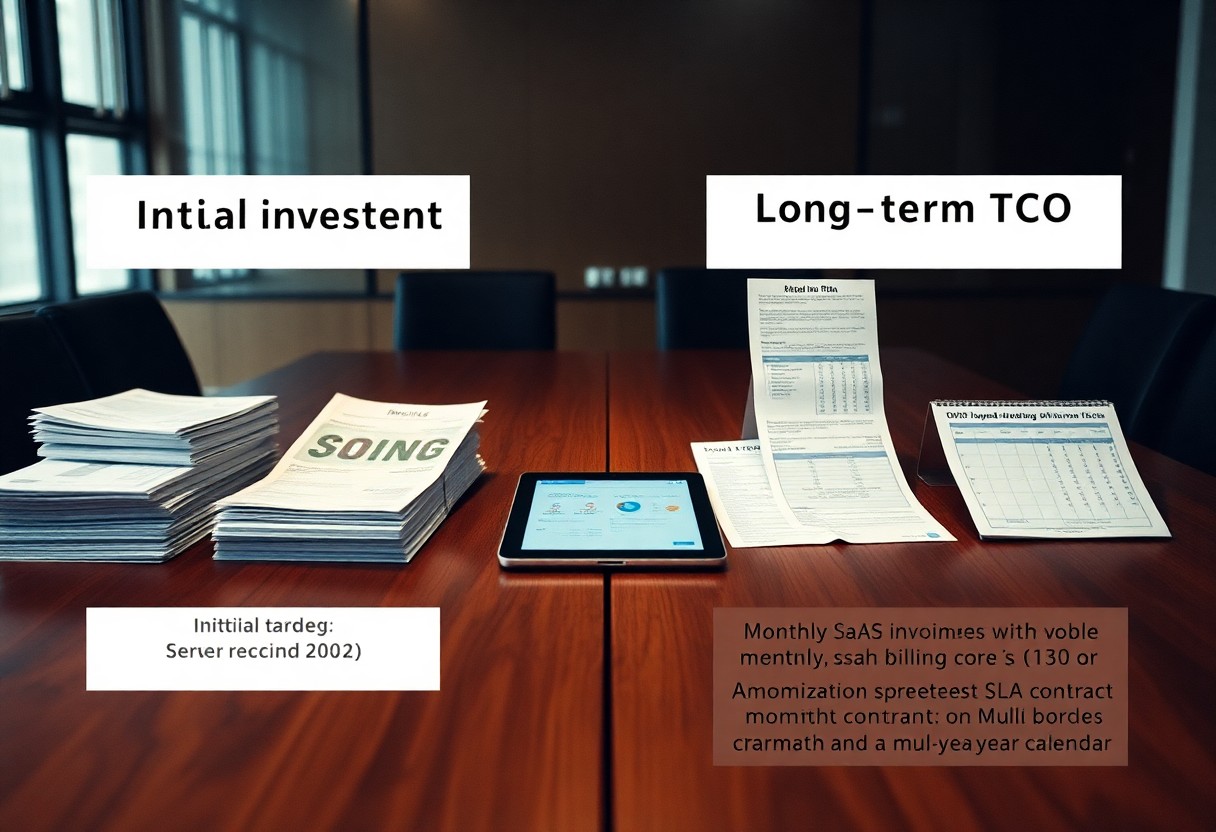
Financial Analysis: Initial Investment vs. Long-term TCO
Comparing custom builds and SaaS means balancing high initial CapEx for custom work against the predictable OpEx of subscriptions; you should run a 3-5 year TCO to see which nets lower total cost. See Custom Software vs. SaaS: Which Is Right for Your Business for a detailed breakdown.
Managing Capital Expenditure (CapEx) in Custom Development
You must budget for development, testing, infrastructure, and future upgrades, accepting larger upfront spend that can be amortized and potentially lower long-term costs if you control scope and maintenance.
Assessing Operational Expenditure (OpEx) and Subscription Creep
Track monthly fees, user-based pricing, and add-ons so you can catch subscription creep early and keep OpEx predictable, ensuring you compare ongoing SaaS costs directly against custom maintenance.
Plan to include hidden OpEx items-training, integrations, downtime, and escalation fees-in your models so you avoid underestimating total spend and can make a defensible investment decision.
Data Sovereignty, Security, and Compliance
You must weigh where your data physically resides: custom software lets you host under local laws, while SaaS often replicates data across regions, increasing the chance of jurisdictional conflicts and regulatory scrutiny.
Contracts you sign should specify encryption responsibilities, breach notification timelines, and liability limits so you avoid unexpected exposure and costly compliance penalties.
Maintaining Absolute Control Over Proprietary Data
When you host on-premises or in a private cloud, you keep authority over encryption keys, access controls, and retention policies, letting you protect sensitive IP and set stricter audit trails than many SaaS providers allow.
Evaluating Third-party Security Protocols in SaaS Environments
Assess vendor certifications (SOC 2, ISO 27001), data residency guarantees, and incident response commitments to confirm their controls match your compliance needs and reduce the risk of delayed breach reporting.
Ask for penetration-test reports, subcontractor lists, and details on encryption at rest and in transit; lack of a right-to-audit clause or unclear key management are high-risk signals that should alter your procurement decision.
Implementation Timelines and Time-to-Market
Custom development forces you to plan for extended cycles: discovery, architecture, build and testing can add months or quarters. You should weigh longer timelines and higher upfront costs against the benefit of tailored workflows and unique competitive features.
SaaS lets you move quickly to production, letting you test ideas and capture revenue sooner. You will face limited customization and potential vendor lock-in, but the faster ROI and predictable subscription model often speed growth.
The Development Lifecycle and Prototyping Phases
Development teams will follow staged milestones you must track: discovery, design, iterative sprints, QA and deployment. You should budget time for integrations and regulatory checks that commonly extend timelines.
Prototyping reduces risk by validating assumptions with users early; you should plan multiple iterations to refine scope. Expect prototypes to reveal integration gaps and usability fixes that shorten long-term rework.
Rapid Deployment and Instant Accessibility of Off-the-Shelf Tools
Cloud-native SaaS gives you immediate access after sign-up, enabling fast pilots and rollouts with minimal setup and lower upfront cost. You must still evaluate compliance and data residency to avoid hidden risks.
Users can scale seats and features on demand while receiving vendor updates automatically; you should prepare for vendor downtime and feature roadmaps that may not match your timeline.
Strategic Decision Framework for Business Leaders
Leaders must weigh your business goals, timelines and risk tolerance when choosing between custom software and SaaS. Use the SaaS vs. Custom Software: 7 Signs Your Business Needs … checklist to compare total cost of ownership, integration needs and security risks.
Assessing scenarios where you need unique workflows, strict compliance or rapid scale will clarify whether bespoke development or subscription services deliver the most strategic value for your growth.
Identifying Competitive Advantages Through Unique Functionality
Options that let you embed proprietary processes can create a competitive moat, but you must weigh development time and potential technical debt against the advantage you gain. You should prioritize features that directly improve customer retention or revenue per user.
Resource Allocation: Internal IT Support vs. Vendor Management
Teams you already have influence the choice: if you have experienced engineers, custom solutions may lower long-term costs, while limited staff often favors SaaS to reduce immediate operational strain on you.
Outsourcing to vendors shifts responsibility but introduces vendor lock-in and contract risk that you must manage through strict SLAs and exit clauses. You will need clear KPIs to measure performance.
Consider budgeting for continuous updates, security patches and integrations so you can compare the real ongoing cost of internal support versus vendor management and make a sustainable decision.
Summing up
Your choice depends on growth stage, budget, and need for customization. SaaS lowers upfront costs, accelerates deployment, and offers predictable updates, making it ideal when you prioritize speed and cost control.
When you require unique workflows, data ownership, or deep integrations, custom software aligns with long-term scale and differentiation, though it demands larger investment and maintenance. Balance immediate needs against future flexibility to decide which path best supports your growth.
FAQ
Q: What are the fundamental differences between custom software and SaaS for growing businesses?
A: Custom software is built from the ground up to match a company’s unique processes, integrations, and competitive features. SaaS (Software as a Service) delivers ready-made, subscription-based applications hosted by a vendor and shared across multiple customers. Custom solutions provide higher control over features, data, and user experience but require larger upfront investment and ongoing development resources. SaaS offers faster deployment, predictable operating costs, and vendor-managed maintenance while limiting deep customization and increasing dependency on the vendor.
Q: How do costs compare between custom software and SaaS over time?
A: SaaS typically requires low initial costs with a recurring subscription that covers hosting, updates, and basic support. Custom software demands significant upfront development spending plus ongoing costs for hosting, maintenance, and enhancements. Total cost of ownership should include subscription fees, integrations, custom development, staff or vendor support, and opportunity cost of delayed features. Growing businesses with tight budgets often prefer SaaS for predictable operating expenses, while companies that need unique capabilities may reach a break-even point where custom development becomes more economical over several years.
Q: How does time-to-market differ between the two options?
A: SaaS enables rapid deployment because products are prebuilt, configurable, and come with onboarding resources. Custom projects require requirements gathering, design, development, testing, and iterations, which lengthen timelines, especially for complex integrations. Choose SaaS when quick adoption, early customer feedback, or validation of a business model is the priority. Choose custom when unique workflows, product differentiation, or strategic intellectual property justify the longer timeline and investment.
Q: Which option scales better as the business grows?
A: SaaS vendors design platforms to scale across many customers and typically offer elastic capacity and tiered pricing to handle growth. Custom solutions can be architected for high performance and tailored scaling strategies, but doing so requires experienced engineering, capacity planning, and higher hosting costs. Evaluate expected user growth, peak loads, and data volume to determine whether multi-tenant SaaS will meet performance needs or whether a dedicated/custom architecture is needed for predictable scaling.
Q: How do maintenance and updates differ between custom software and SaaS?
A: SaaS providers handle security patches, feature updates, and infrastructure maintenance as part of the service, which reduces internal engineering hours. Custom software shifts responsibility for fixes, updates, and technical debt to the company or its vendors, creating ongoing staffing or contract costs. Ask about service-level agreements, release cadence, rollback procedures, and access to source code when assessing long-term maintenance risk. Favor SaaS if engineering capacity is limited; favor custom if control over update timing and roadmap is a priority.
Q: What should growing businesses consider about security and compliance?
A: SaaS vendors often provide certifications such as SOC 2, ISO 27001, or HIPAA support and invest in standardized security controls across their platform. Custom implementations allow precise control over data residency, encryption, access control, and audit trails required for strict regulatory needs, but they demand investment in security expertise and continuous assessments. Perform vendor security reviews, request third-party audit reports, and map controls against your compliance requirements. Choose custom when regulatory demands or sensitive intellectual property cannot be satisfied by a shared SaaS environment.
Q: What practical criteria should guide the decision between custom software and SaaS?
A: Assess business priorities: speed to market, total cost, product differentiation, control over data, compliance requirements, and internal technical capability. Create a must-have versus nice-to-have feature list and compare how well SaaS products meet those needs and what customization would cost. Calculate a three- to five-year total cost of ownership including subscriptions, customization, integration, and personnel. Run a pilot with a SaaS product to validate processes quickly before committing to custom development. Use a decision matrix that weights timeline, budget, competitive advantage, and governance to choose the option aligned with growth plans.